Majority of Water Reabsorption in Kidney
I was taught the proximal convulated tubule is where most of the water absorption occurs. Over 70 the filtrate is reabsorbed.

Tubular Reabsorption Article Article Khan Academy
Overall about 67 of the filtered water is reabsorbed in the PCT.

. Increased ADH secretion and increased water reabsorption. Water reabsorption occurs in the thin descending limb of the Loop of Henle. The majority of water reabsorption from the filtrate occurs in the proximal convoluted tubule PCT.
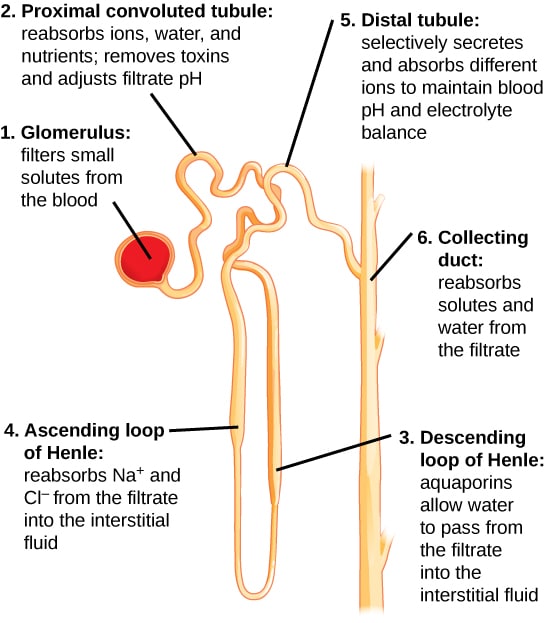
Most of the fluid that is filtered at the glomerulus is then reabsorbed in the proximal tubule and the descending limb of the loop of Henle. Fifty percent of Cl and variable quantities of Ca 2 Mg 2 and. The first time being when they were absorbed into the bloodstream from the digestive tract after a meal.
Loop of Henle long U-shaped portion of the tubule that conducts urine within each nephron qv of the kidney of reptiles birds and mammals. The diluted filtrate that goes into the descending loop is concentrated as water is also reabsorbed but the absolute amount of water reabsorbed here is less. This increase results in reabsorption of up to 15 percent of the water entering the nephron.
Most of the fluid that is filtered at the glomerulus is then reabsorbed in the proximal tubule and the descending limb of the loop of Henle. The nephron is the functional unit of the kidney which plays key role in the removal of waste product from the body. Most of the solutes that were filtered in the glomerulus have now been recovered along with a.
Click to select 2. What structure carries urine out of the kidney and where does it go. That recovery occurs in the PCT loop of Henle DCT and the collecting ducts and.
Most water reabsorption takes place in the proximal convoluted tubules part of the nephrons in the kidney. Tubular reabsorption is the process that moves solutes and water out of the filtrate and back into your bloodstream. About 67 percent of the water Na and K entering the nephron is reabsorbed in the proximal convoluted tubule and returned to the circulation.
Which area of the kidney contains the glomeruli and Bowmans capsule. During a kidney transplant procedure the renal artery and vein of the donor kidney are connected to the recipients. Click to select 3.
With up to 180 liters per day passing through the nephrons of the kidney it is quite obvious that most of that fluid and its contents must be reabsorbed. In which part of the kidney does the majority of water reabsorption occur. The nephrons need to re-absorb water in order to further convert this into materials that can be.
Click to select 4. Amino acids are reabsorbed in this. Nephron consists of glomerulus and convoluted tubules.
-The majority of water reabsorption occurs in the _____ nephron loop renal corpuscle proximal convoluted tubule distal convoluted tubulecollecting duct region-_____ Type III Type II Type I alveolar pneumocyte cells secrete surfactant. The nephrons are the part of the kidneys that are responsible both for the absorption and re-absorption of water within the kidneys. The nephrons are the part of the kidneys that are responsible both for the absorption and re-absorption of water within the kidneys.
Most of the filtrate reabsorption takes place here too. Water sodium potassium chloride urea glucose amino acids bicarbonate and phosphate all get reabsorbed in the proximal convoluted tubule. Various portions of the nephron differ in their capacity to reabsorb water and specific solutes.
Site where the majority of reabsorption takes place. Approximately two-thirds of the water sodium and potassium that was filtered in the renal corpuscle is reabsorbed back into the vasculature at the proximal tubule. In humans the system accounts for 45 of the kidneys reabsorption of sodium and 5 of the kidneys reabsorption of water.
These nephrons have a network or chain of command that filters large molecules such as proteins and cells within the kidneys. The diffusion of water from an area of high water potential to an area of low water potential through a partially permeable membrane. This process is known as reabsorption because this is the second time they have been absorbed.
The majority of reabsorption occurs in the. The majority of water reabsorption that occurs in the nephron is facilitated by the AQPs. Modest amounts of urea Na and other ions are also recovered here.
Parts of the nephron. H20 Sodium and Potassium. The proximal convoluted tubule is where a majority of reabsorption occurs.
The majority of water reabsorption that occurs in the nephron is facilitated by the AQPs. Bulk reabsorption which is not under hormonal control occurs largely in the proximal tubule. Reabsorption of water and specific solutes occurs to varying degrees over the entire length of the renal tubule.
Match the region of the kidney tubule with its description 1. From the ureter to the bladder peristalsis. Water is reabsorbed by a process called osmosis.
The countercurrent multiplier is a system by which the. Reabsorption is the movement of water and solutes from the tubule back into the plasma. By the end of the PCT the concentration of water in the filtrate and interstitial space is almost the same.
It is permeable to water which means that H 2 O molecules are freely able to leave it. How does the loop of Henle work. These nephrons have a network or chain of command that filters large molecules such as proteins and cells within the kidneys.
Permeability to water and solutes in this region varies based on hormone regulation. Contains simple squamous epithelium in the thin segments.

Magnesium Reabsorption Along The Nephron The Glomerulus Filters The Download Scientific Diagram
Water Filtration And Reabsorption Urinary Teachmephysiology
Tubular Reabsorption Anatomy And Physiology Ii
Comments
Post a Comment